
Snickerdoodles are usually just sweet, cinnamon-sugar coated cookies, right? But I’ve always loved giving them a little twist—something unexpected, like a hint of cardamom or a splash of lemon zest. It’s like taking a nostalgic hug and adding a whisper of surprise that keeps everyone guessing.
Baking these with that extra spice or citrus isn’t about reinventing the wheel; it’s about deepening the flavor, making each bite more layered and memorable. I find myself craving the familiar crunch and chewy center, but with a little more complexity—kind of like a secret handshake in cookie form.
This recipe isn’t just about the ingredients. It’s about the little moments—measuring out spices while the oven preheats, the aroma that fills the kitchen, that satisfying crackle as they come out of the oven—that’s where the magic happens.
Focusing on the nostalgic charm of snickerdoodles, but with a twist: using unexpected spices like cardamom and a splash of lemon zest to elevate the classic cookie into a more complex, multi-layered treat.
The story behind this recipe
- My love for snickerdoodles started in my grandmother’s kitchen, where she’d whip up a batch on chilly afternoons. There was something about the warm cinnamon aroma that made the winter days feel extra cozy, almost like a secret family hug. Over the years, I’ve tinkered with different spices and zest to keep that nostalgic feeling alive but with a bit of my own twist.
- One winter, I found a forgotten jar of cardamom in the back of my spice drawer. I sprinkled a pinch into my usual sugar-cinnamon mix, and the cookies took on a new life—more fragrant, slightly exotic. That moment of surprise made me realize how small tweaks can turn a familiar favorite into something fresh and memorable.
- heading: The story behind this recipe
Key Ingredients Breakdown
- Unsalted butter: I like it soft so it creams easily, and it gives a rich, mellow flavor. You can swap with margarine, but it’ll be less tender and more artificial-tasting.
- Granulated sugar: It’s the sweet backbone of these cookies, and I prefer superfine for a smoother mix. Try coconut sugar if you want a caramel note—just expect a darker cookie.
- All-purpose flour: I always measure by spoon and level—too much makes them dense. For a lighter crumb, you could try half whole wheat, but it’ll have a nuttier flavor.
- Cream of tartar: This gives the cookies that signature tangy lift and chewy texture. Skip it if you’re out—baking soda alone won’t give the same tang, but it’ll still rise.
- Cinnamon: I use a good, fragrant cinnamon—nothing too dull. For a bit of heat, add a pinch of cayenne, or try nutmeg for warmth, but keep it subtle.
- Lemon zest: It brightens the sugar and spice, adding a fresh, zingy aroma. Skip if you want pure traditional, but trust me, it elevates the flavor.
- Sugar for coating: I like a mix of cinnamon and sugar here, but a simple sugar sprinkle works too. Use coarse sugar if you want a crunchier crust.
Spotlight on key ingredients
Cinnamon:
- I love a fragrant, slightly spicy cinnamon that smells like cozy mornings. Its behavior during baking releases a warm aroma that fills the kitchen, and it clings to the sugar coating beautifully.
- Lemon zest: Brightens the dough with a fresh, citrusy note. It adds a zesty pop that balances the sweetness and releases a vibrant aroma when baked, making the cookies feel more layered and lively.
Sugar for coating:
- Cream of tartar: This tangy powder gives the cookies their signature chew and crackly top. During baking, it reacts with baking soda to produce that classic snickerdoodle texture, and it helps the cookies hold their shape.
- The coarse sugar mixed with cinnamon creates a crunchy, sweet crust. As the cookies bake, it caramelizes slightly, offering that satisfying crackle and a sweet aroma that beckons with every bite.
Notes for ingredient swaps
- Dairy-Free: Swap butter for coconut oil or vegan margarine. Expect a slightly different richness and a hint of coconut aroma.
- Sugar: Use honey or maple syrup instead of granulated sugar. The dough will be a bit softer and the cookies slightly chewier.
- Flour: Replace half with almond flour for a nuttier flavor and a softer crumb, but reduce the liquid slightly.
- Cinnamon: Substitute with pumpkin pie spice for a warm, complex aroma or add a pinch of ground ginger for extra warmth.
- Lemon Zest: Swap with orange zest for a sweeter, citrusy twist or skip it for a more traditional flavor.
- Coating Sugar: Use turbinado sugar for a crunchier, caramelized crust or brown sugar for a deeper, molasses note.
Equipment & Tools
- Large mixing bowl: To cream butter and sugar and mix ingredients thoroughly.
- Measuring cups and spoons: For precise measurement of ingredients.
- Silicone spatula: To fold ingredients gently and prevent overmixing.
- Baking sheet: To bake the cookies evenly.
- Parchment paper: To prevent sticking and promote even baking.
- Cooling rack: To cool cookies without sogginess.
Step-by-step guide to snickerdoodles
- Equipment & Tools: Gather a large mixing bowl (for cream and mixing), a measuring cup and spoons (for precise measurements), a silicone spatula (for folding), a baking sheet (for cookies), parchment paper (to prevent sticking), and a cooling rack (for resting).
- Preheat your oven to 180°C (350°F). Line the baking sheet with parchment to keep cookies from sticking and ensure even baking.
- In the large bowl, cream 1 cup (226g) softened unsalted butter with 1 1/2 cups (300g) granulated sugar until fluffy, about 2-3 minutes. Smell the sweet, buttery aroma as it combines.
- Add 2 large eggs, one at a time, mixing well after each. Now the mixture should be smooth and slightly glossy, with a faint vanilla scent.
- Stir in 1 teaspoon (5g) cream of tartar, 1 teaspoon (4g) baking soda, 1/2 teaspoon (1g) ground cinnamon, 1 teaspoon (2g) lemon zest, and a pinch of salt. Mix until evenly distributed, the dough should smell fragrant and slightly tangy.
- Gradually add 2 3/4 cups (340g) all-purpose flour, folding gently with the spatula. Avoid overmixing; the dough should come together but remain soft. If it’s too sticky, chill for 15 minutes.
- For the cinnamon-sugar coating, mix 1/4 cup (50g) sugar with 1 teaspoon (2g) cinnamon. Set aside.
- Scoop about 1 1/2 tablespoons of dough for each cookie, roll into balls, then roll in the cinnamon-sugar mixture. Place on the prepared baking sheet, spacing about 5cm (2 inches) apart.
- Bake for 10-12 minutes. Check for golden edges and a slight crackle on top. The cookies should be set but still soft in the center, with a warm cinnamon aroma filling the kitchen.
- Remove from oven, let cool on the baking sheet for 5 minutes until they firm slightly. Then transfer to a cooling rack to cool completely—about 15 minutes. The cookies will set up with a chewy center and crispy edges.
- Finish by dusting lightly with more cinnamon sugar if desired, or serve as is once fully cooled.
Let the cookies cool completely on a rack before serving. Optional: dust with extra cinnamon sugar for added flavor and visual appeal.
How to Know It’s Done
- Edges are golden and slightly crisp, with a crackled top.
- Center feels soft but not raw when gently pressed.
- Cookies have a fragrant cinnamon aroma and a slight bounce when touched.
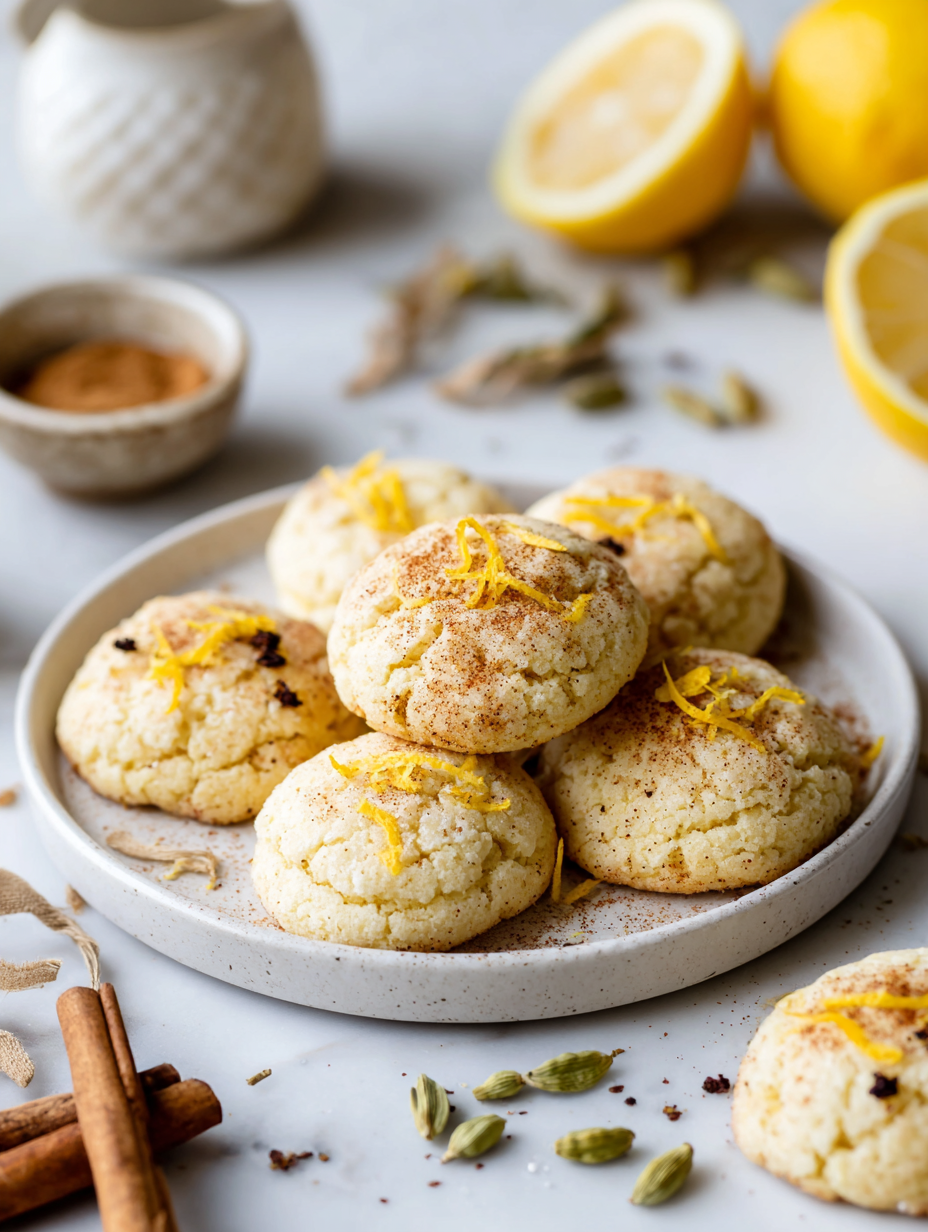
Spiced Lemon Cardamom Snickerdoodles
Ingredients
Equipment
Method
- Preheat your oven to 180°C (350°F) and line a baking sheet with parchment paper to prevent sticking.
- In a large mixing bowl, cream together the softened butter and granulated sugar until the mixture is light, fluffy, and fragrant, about 2-3 minutes. You should see it turn pale and feel a slight resistance when you stir.
- Add the eggs one at a time, mixing well after each addition, until the mixture is smooth and glossy with a subtle vanilla aroma.
- Stir in the cream of tartar, baking soda, ground cinnamon, lemon zest, and a pinch of salt, mixing until evenly combined. The dough will become fragrant with citrus and spice.
- Gradually add the flour, folding it into the wet mixture with a spatula until just combined. The dough should be soft but manageable. If it feels sticky, chill it in the fridge for 15 minutes.
- In a small bowl, combine the sugar for coating with the additional cinnamon, mixing well to evenly distribute.
- Scoop about 1 1/2 tablespoons of dough, roll into balls, then generously roll each in the cinnamon-sugar mixture, coating all sides evenly.
- Place the coated dough balls onto the prepared baking sheet, spacing them about 5cm (2 inches) apart to allow for spreading.
- Bake in the preheated oven for 10-12 minutes, or until the edges are golden and crackly, and the tops are set with a fragrant cinnamon aroma.
- Remove the cookies from the oven and let them cool on the baking sheet for 5 minutes, allowing them to set and develop their chewy, crackled texture.
- Transfer the cookies to a cooling rack and let them cool completely. Once cooled, enjoy their crisp exterior, chewy center, and layered citrus-spice aroma.
Pro tips for perfect snickerdoodles
- Use room temperature butter for a smoother, more even cream. Cold butter will make mixing harder.
- Measure flour carefully—spoon it into your cup and level off to avoid dense cookies.
- Add lemon zest early in the mixing to fully release its bright aroma and flavor.
- When rolling dough balls, keep them uniform in size for even baking and consistent texture.
- Bake until edges are just golden; overbaking leads to crisp cookies, underbaking keeps them doughy.
- Let cookies rest on the baking sheet for 5 minutes after baking to set their shape and flavor.
- Use coarse sugar for coating; it creates a delightful crunch and caramelizes slightly in the oven.
Common mistakes and how to fix them
- FORGOT to check oven temperature → Use an oven thermometer for accuracy.
- DUMPED the sugar mixture early → Cream butter and sugar thoroughly before adding eggs.
- OVER-TORCHED cookies → Bake at an even 180°C (350°F), rotate sheet if needed.
- MISSED resting time → Let cookies cool completely for optimal texture and flavor.
Quick fixes and pantry swaps
- If cookies spread too much → Chill dough for 15 minutes before baking.
- When sugar isn’t sticking → Slightly dampen your hands to help roll the dough.
- Splash water on the baking sheet → Prevent sticking if parchment isn’t available.
- Patch underbaked cookies → Return to oven for another 2-3 minutes, watch for golden edges.
- Shield burnt bottoms → Use an oven thermometer and rotate sheet halfway through baking.
Prep, store, and reheat tips
- Prepare the cinnamon-sugar coating mixture in advance; store in an airtight container for up to a week, and enjoy the fragrant, spicy aroma when you roll the cookies.
- Dough can be made ahead and refrigerated for up to 24 hours—just cover tightly to prevent drying out and bring to room temperature before baking for even spreading.
- Baked cookies keep well in an airtight container at room temperature for 3-4 days; for longer storage, freeze for up to a month, wrapped tightly to prevent freezer burn.
- Reheat cookies in a 150°C (300°F) oven for 5 minutes until slightly warm and fragrant again—watch for that crackling sound and softened texture.
Top questions about snickerdoodles
1. Can I use margarine instead of butter?
Use room temperature butter for easy creaming and better texture. Cold butter makes mixing tougher.
2. Can I substitute margarine for butter?
Yes, but your cookies might be less tender and have a slightly artificial flavor. Stick with butter if you can.
3. Can I use coconut oil instead of butter?
Absolutely. Coconut oil works well, but expect a slightly different crumb and a mild coconut aroma.
4. Can I swap sugar with honey or syrup?
Yes, you can replace granulated sugar with honey or maple syrup, but your dough will be softer and cookies chewier.
5. Can I use almond flour instead of all-purpose?
Yes, replace half the flour with almond flour for a nuttier taste, but reduce liquids slightly to prevent spreading.
6. Can I omit lemon zest or switch it?
Skip lemon zest for a traditional flavor or swap with orange zest for a sweeter citrus punch.
7. What other sugars can I use for coating?
Yes, use turbinado or brown sugar for a crunchier crust or deeper molasses flavor in the coating.
8. What makes good cinnamon for baking?
Cinnamon should be fragrant and fresh—during baking, it releases a warm, spicy aroma that makes the kitchen smell inviting.
9. Why do I need cream of tartar?
Cream of tartar gives the cookies their chewy texture and crackly top. It reacts with baking soda during baking.
10. How do I know when snickerdoodles are done?
Ensure cookies are golden at the edges, slightly soft in the center, and smell fragrant when done.
These cookies aren’t just a sweet treat; they’re a little reminder of how simple ingredients can turn into something special. Making them with that unexpected twist of lemon zest and extra spice feels like sharing a secret with everyone at the table.
In a world that moves so fast, it’s nice to have a recipe that calls for a bit of patience and some honest baking. Each batch is a small moment of joy, a little bit of chaos, and a lot of comfort all rolled into one.

Hi, I’m Charlotte Hayes, the creator and storyteller behind Lost in the Aroma. If you’ve ever closed your eyes while something simmered on the stove just to take in the scent, then you already understand what this space is about. For me, aroma is memory. It is emotion. It is the first sign that something beautiful is about to be shared. Lost in the Aroma is where I bring together recipes, sensory storytelling, and my lifelong love for food. I am so glad you’re here.
Leave a Reply